

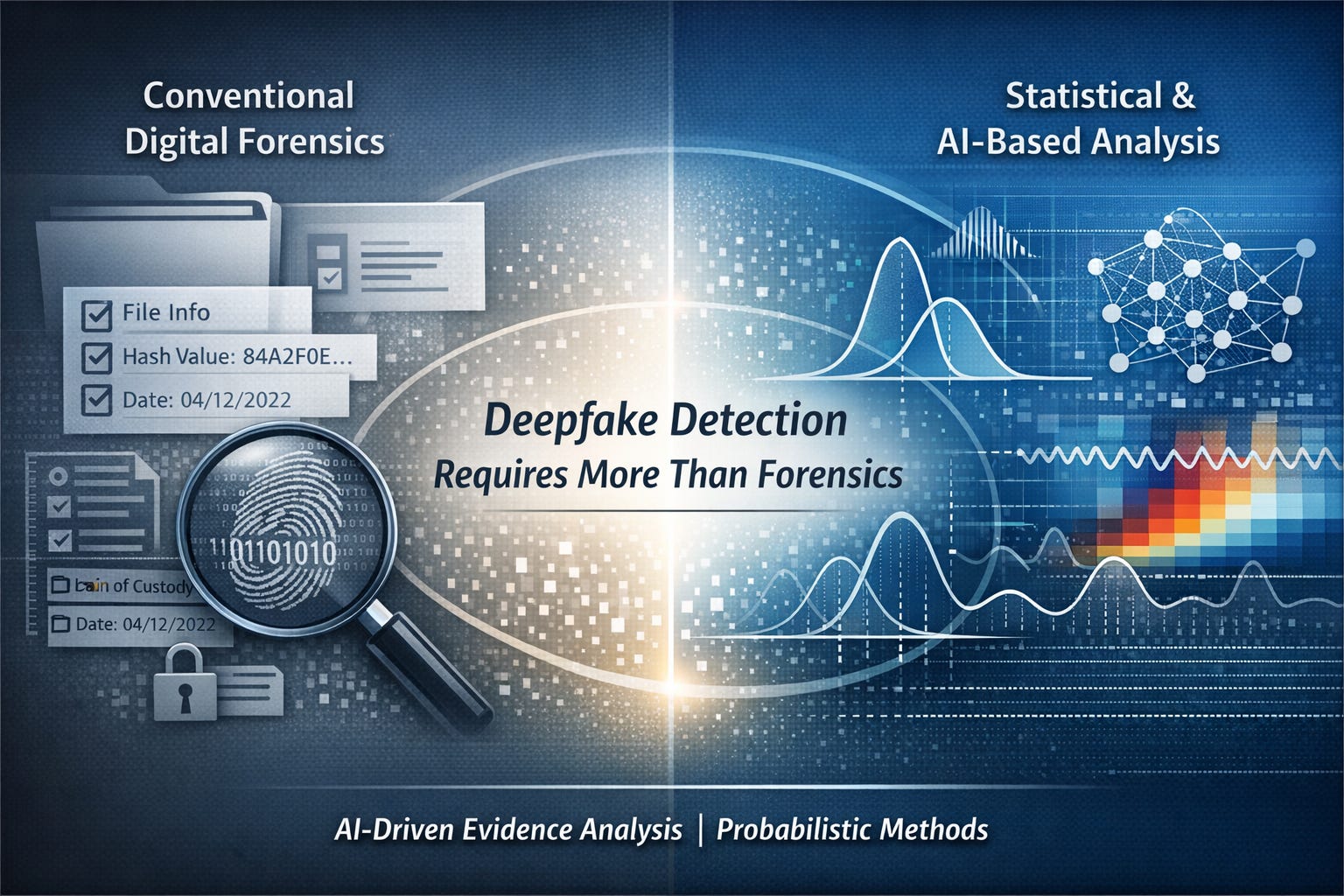
The detection of deepfakes has evolved beyond the exclusive domain of digital forensics and is now fundamentally a data science challenge. While traditional forensic skills regarding the chain of custody, file system analysis, metadata inspection, and courtroom defensibility remain essential foundations, they are insufficient for identifying modern synthetic media. Artificial intelligence generates images, audio, and video that conventional indicators often fail to detect because these manipulations are probabilistic rather than procedural in nature. Consequently, generative models leave statistical fingerprints rather than obvious artifacts.
Identifying these fabrications increasingly requires feature extraction on a large scale, including the analysis of frequency domain anomalies, residuals from generative adversarial networks, and inconsistencies within latent space. The methodology must shift from binary authentication checks to probabilistic modeling and the use of population level baselines to distinguish rare manipulation signals from normal variation. Additionally, this process necessitates model uncertainty estimation that is appropriate for legal and investigative contexts.
Much like disease surveillance, deepfake detection is about:
distinguishing signal from noise under uncertainty, estimating likelihood rather than asserting absolutes, and explaining results in a way that decision-makers and courts can understand.
Data scientists, particularly those trained in applied statistics and real world evidence, act as vital collaborators in this effort. Similar to disease surveillance, deepfake detection involves distinguishing signal from noise under conditions of uncertainty and explaining the results as likelihood estimates to decision makers. While digital forensics determines what specific actions were performed on a file, data science estimates the probability that the file could exist without manipulation. The future of evidence verification relies on the integration of forensics and data science to protect due process and vulnerable populations from sophisticated deception. For investigators and attorneys, this interdisciplinary collaboration represents a necessary risk management strategy.